
Changing Printing Materials
Before producing models using a different type of printing material than is currently installed, run the Material Replacement wizard to flush the print block and feed tubes. The factors that are relevant when changing materials are the print mode, printing material, and the specific printer.
To ensure the biocompatibility of printed parts when changing from standard printing materials to biocompatible materials, follow the instructions for loading the relevant material. To download the required document, search for "Biocompatibility Requirements" on the Stratasys Support Center.
| • | High Quality Speed |
This mode enables you to produce 3D prints with 3 model materials. Each print head section is loaded with a different material.
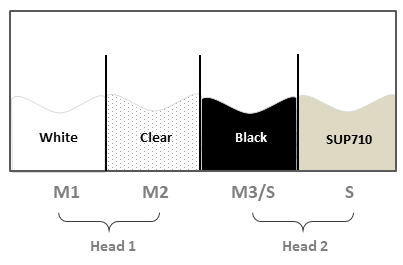
Do not load MED625FLX in the M3 cartridge slot. For information about biocompatible materials, search for "Biocompatibility Requirements" on the Stratasys Support Center.
Tip for printing in High Quality Speed mode:
- You cannot switch directly between Digital ABS Plus and Elastico materials. To switch between these materials, you must first perform material replacement using another material, such as a Vero material, and then perform material replacement to the desired material.
| • | Long Print |
This mode enables you to load more cartridges of a single material thereby significantly reducing the need to replace cartridges during the print job. The cartridges of the material you wish to print without replacing, must be loaded in the channels of the same print head.
Three print head setup options are available, as shown below.
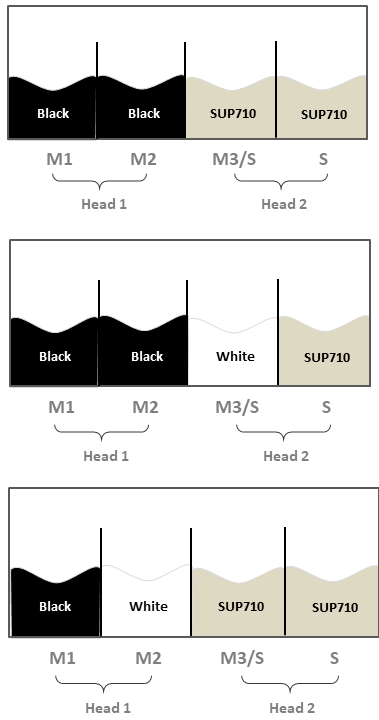
Do not load MED625FLX in the M3 cartridge slot. For information about biocompatible materials, search for "Biocompatibility Requirements" on the Stratasys Support Center.
Tips for Long Print mode:
- A support cartridge must be loaded in the S channel.
- If an additional support cartridge is needed, it must be loaded in the M3/S cartridge slot.
- In this mode, you cannot use Elastico materials.
- When loading the channels with 2 different model materials and 1 support cartridge, M1 and M2 must be loaded with the same model material. See Option 2 in Loading Model and Support Cartridges.
| • | High Quality High Speed (J3 DentaJet only) |
This mode enables faster printing while maintaining model quality. The loading of the cartridges is with 2 cartridges of the same model material and 2 cartridges of the same support material.
The print speed is double the speed of High Quality Speed and Long Print modes.
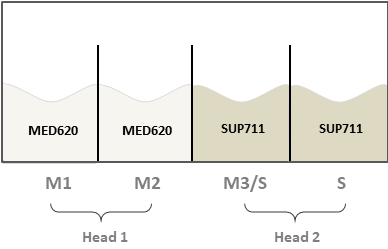
Do not load MED625FLX in the M3 cartridge slot. For information about biocompatible materials, search for "Biocompatibility Requirements" on the Stratasys Support Center.
To replace the printing materials:
| 1. | From the Wizards screen, tap . |
| 2. | In the opening screen, tap . |
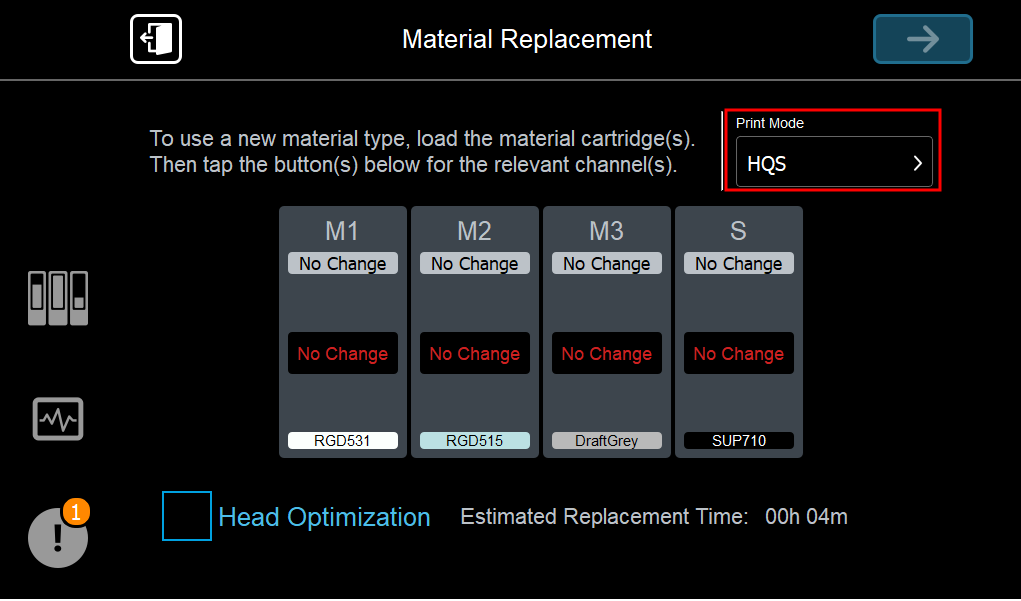
The main material replacement screen shows the materials currently loaded in each of the Model channels (M1–M3) and in the Support channel (S).
a. In Print Mode, tap .
The print modes appear as the following abbreviations in the main screen:
| • | HQS—High Quality Speed |
| • | LP—Long Print |
| • | HQHS—High Quality High Speed |
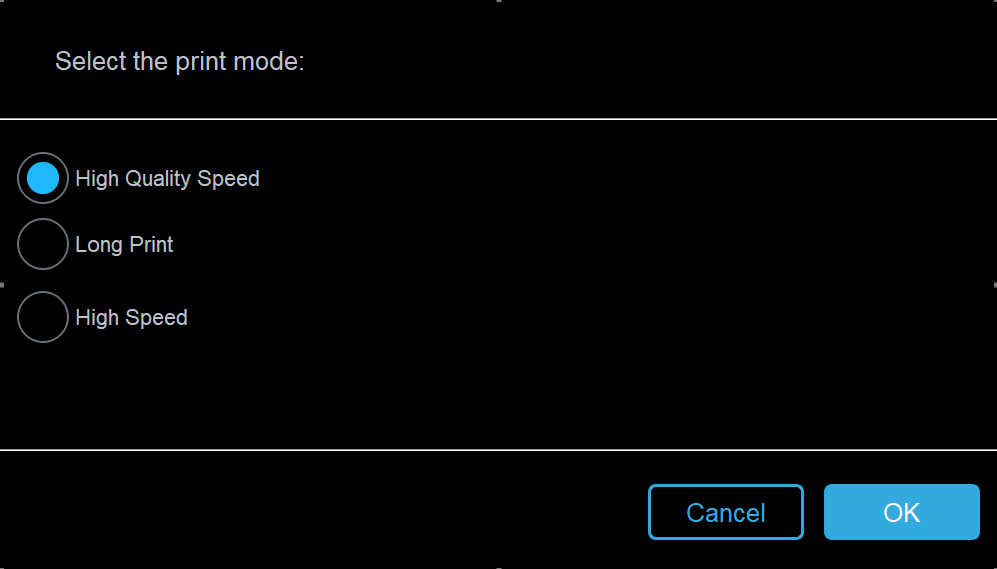
b. Select the print mode and tap .
The displayed print modes depend on the printer type.
| 3. | To change the material in a channel, load a cartridge of the new material into the material cabinet for the selected channel. |
| 4. | In the wizard screen, for the relevant cartridge slot, tap for that cartridge slot. |
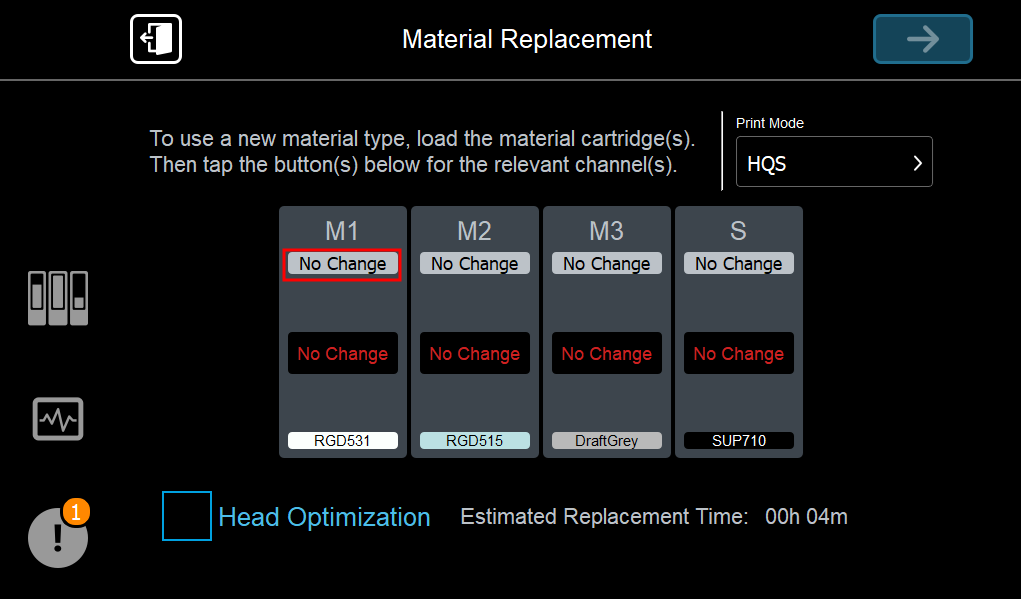
| 5. | In the material selection screen for the selected channel, verify that the material cartridge you loaded in the materials cabinet appears at the bottom of the screen. |
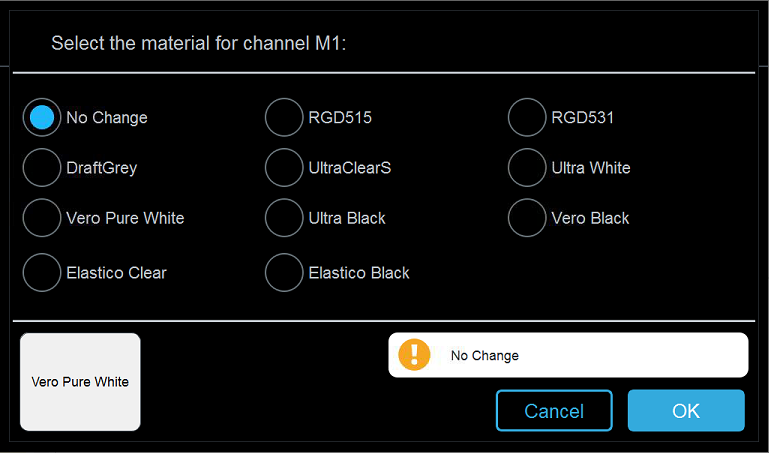
| 6. | Select the new material. |
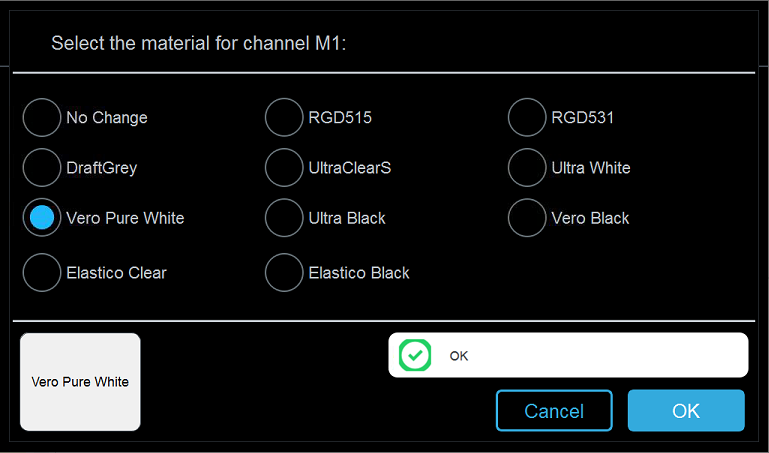
indicates that there is enough material loaded in the  appears in the cartridge status message box, resolve the issue, if relevant.
| • | indicates that no material has been selected. If you do not need to change the material, no action is necessary. |
| • | indicates that the selected material is different than the currently loaded cartridge. Load the selected material or select another material. |
| • | indicates that the material is selected for more channels than allowed by the selected print mode. Select a different material in one of the slots. |
| • | indicates that there is not enough material loaded in the slot. Load a cartridge in the slot. |
For more information about cartridge statuses, see Cartridge Statuses
| 7. | Tap . |
| 8. | In the main material replacement screen, verify that the new material appears in the cartridge slot. |
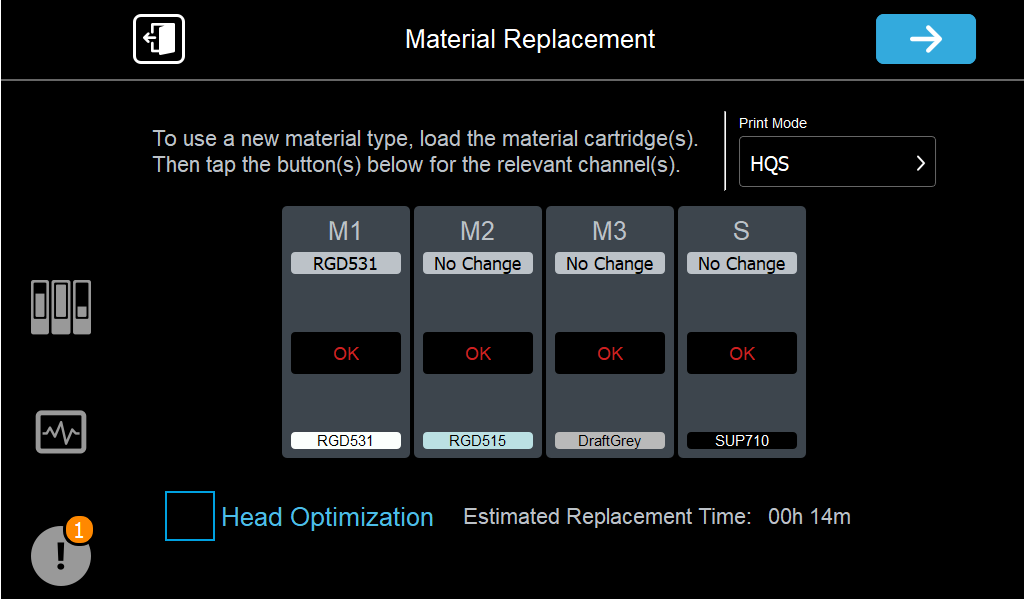
Replacing certain materials requires print-head optimization. If this is the case, Head Optimization is selected automatically in the Material Replacement screen.

Note: If Head Optimization is selected, run the Advanced Head Optimization wizard after completing the Material Replacement wizard, before printing.
| 9. | Replace materials in all of the required cartridge slots and then note the estimated replacement time. |
| 10. | Tap . |
If you continue, you must complete the material replacement process before you can print models. To replace material cartridges at another time, tap Cancel. If you continue (by tapping Next) and you do not complete the process, you will need to run the wizard again before printing.
| 11. | After tapping , follow the instructions in the wizard screens. |
To complete the material replacement process:
- When replacing printing materials (Model and Support) with other printing materials, the printer prints a model in the shape of an arc.
- When replacing printing materials with cleaning fluid, the printer purges.
 Related Topic